
My Cart (0 )
-
Previous

FXRα ORF cDNA Lentivirus
$595.00
-
Next
PPAR-alpha Reporter Lentivirus
$595.00
BRE Reporter Lentivirus
Price range: $595.00 through $695.00
BRE Reporter Lentivirus: High-quality, lentiviral transcription factor (TF) reporter system that provides a sensitive fluorescent or luminescent readout for human/mouse bone morphogenic protein (BMP) signaling pathway in mammalian cells. The lentiviral construct contains inverted repeats of mouse Id2 promoter BMP response elements (BRE) plus Smad4 DNA-binding motif. Upon BMP signaling pathway activation, Smad1/5/8 are activated and form a complex with Smad4 that binds the BRE, directing transcription of the reporter gene. The BMP signaling pathway is associated with embryogenesis, organ development, and adult tissue homeostasis. The reporter lentivirus is purified by PEG precipitation and sucrose gradient centrifugation, and is ideal for studying BMP signaling pathways in difficult-to-transfect cells including primary and/or thawed cells.
Have questions about this product? Need a stable cell line? Send us a form and we’ll reply the same day: Contact Us
Ultra-high concentration virus can be provided upon request in your choice of medium and volume for in vivo injection. We can provide custom reporter genes (such as SEAP, YFP, secreted Gaussia Luc, Renilla Luc, etc.) and selection markers (hygromycin, bleomycin, etc.) upon request.
Available Options:
Specifications
Details
| LTV-0075 | |
| Bone morphogenic protein (BMP) Signaling Pathway | |
| BMP response elements (BRE) | |
| Monitor transcriptional activity of bone morphogenic protein (BMP) signaling pathway in mammalian cells, screen for activators or inhibitors of BMP signaling pathway. The fluorescent reporter enables convenient readout using flow cytometry, fluorescence microscopy, etc. The BMP response element (BRE) reporter lentivirus is constructed with inverted repeats of mouse Id2 promoter BRE plus Smad4 DNA-binding motif to respond to BMP proteins. BMP signaling pathway is associated with embryogenesis, organ development, and adult tissue homeostasis. Smad1/5/8 are activated by BMP signal transduction, which form a complex with Smad4 that binds BRE sites in the promoters of target genes to regulate gene expression. | |
| Human/mouse |
Product Data
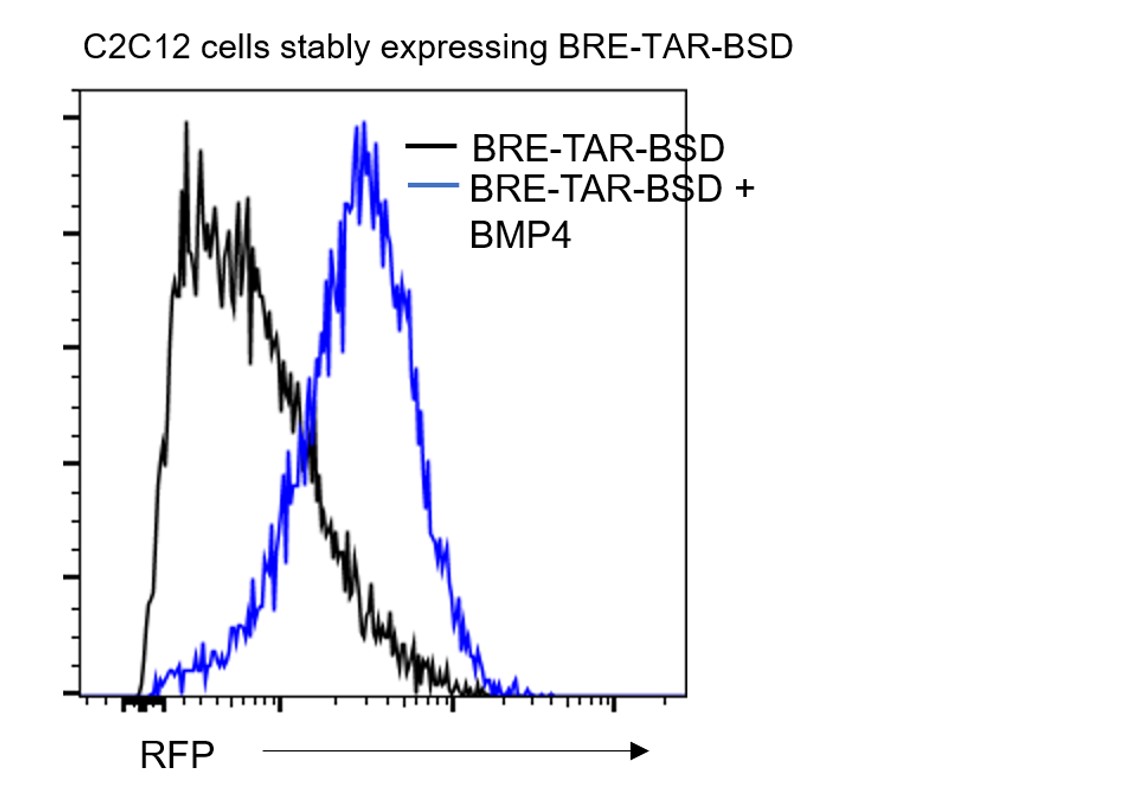
Figure 1 . C2C12 cells (1×10^6) were infected with 50 μl of BRE-TAR-BSD lentivirus in a 6-well plate and incubated for 24 hours. The culture medium was then replaced with fresh medium. The cells were further cultured for an additional 24 hours and then transferred to a 100mm dish. The overnight-cultured cells were treated with 10 µg/ml BSD for 24 hours and subsequently replenished with new medium containing 10 μg/ml BSD daily until dead cells were removed and transfected cells started growing. After approximately one week of transduction, the transfected cells in a 12-well plate were treated with 50 ng/ml BMP for 24 hours prior to flow cytometry analysis to detect the BRE-driven expression of RFP.

Figure 2 . C2C12 cells (1×10^5) were transduced with 80 µl BRE-β-Gal-BSD lentiviral particles (6µg/ml polybrene) in a 12-well plate for three days. The cells were then passaged into a 6-well plate and selected with 10 µg/ml BSD to obtain stable cells. The stable cells were treated with 50 ng/ml BMP4 for 16 hours, then fixed with PFA and stable with X-gel solution in β-Gal assay buffer.
Have questions about this product? Send us a form and we’ll reply the same day: Contact Us
Recommended Controls
Renilla Luciferase Internal Control Lentivirus – Ready-to-transduce lentiviral particles expressing minimal TATA box-driven Renilla luciferase (RLuc).
Reporter Negative Control Lentivirus – Ready-to-transduce lentiviral particles expressing minimal TATA box-driven reporter. The construct is the same as the TF Reporters except that it lacks the transcriptional response elements which drive signal pathway/TF-specific reporter expression. The reporter negative control lentiviral particles allow to establish a baseline for background reporter activity and determine specificity of any treatments to activate the reporter.
Reporter Positive Control Lentivirus – Ready-to-transduce lentiviral particles with constitutive expression of the reporter. The reporter positive control lentivirus is useful for transduction optimization studies, especially if the cells are very sensitive or difficult-to-transduce.
Custom Orders
If you require a modification to one of our products, such as a change in reporter or other vector component, contact us. We provide fast and efficient custom lentiviral particles on demand.
Or, send us your cells and we will establish a stable reporter cell line for you using this product. Learn more.
ORF cDNA plasmids featured in the product figures are available upon request.
Quick Links: