
My Cart (0 )
-
Previous

PitRE Reporter Lentivirus
$595.00
-
Next

FOXD1 Reporter Lentivirus
$595.00

T-Pit/PitX1 Reporter Lentivirus
$595.00
T-Pit/PitX1 Reporter Lentivirus: A high-quality lentiviral reporter for the detection of synergistic transcriptional activities of T-Pit and PitX1. The construct utilizes tandem repeats of T-Pit and PitX1 response elements, called CE3 elements, and is designed to read out the synergistic activities of these two transcription factors in activating corticotropin-releasing hormone (CRH) and pro-opiomelanocortin (POMC), a precursor of multiple peptide hormones, in pituitary glands. The reporter lentivirus is purified by PEG precipitation and sucrose gradient centrifugation and is ideal for difficult-to-transfect cells including primary and/or thawed cells.
Have questions about this product? Need a stable cell line? Send us a form and we’ll reply the same day: Contact Us
Ultra-high concentration virus can be provided upon request in your choice of medium and volume for in vivo injection. We can provide custom reporter genes (such as SEAP, YFP, secreted Gaussia Luc, Renilla Luc, etc.) and selection markers (hygromycin, bleomycin, etc.) upon request.
Available Options:
Specifications
Details
| LTV-0116 | |
| T-Pit (TBX19) and PitX1 coordinated transcriptional activities | |
| T-Pit (TBX19) and PitX1 response elements (CE3 elements) | |
| Monitor T-Pit (TBX19) and PitX1 coordinated transcriptional activities in mammalian cells, screen for activators or inhibitors of T-Pit/PitX1 transcriptional activity . The fluorescent reporter enables convenient readout using flow cytometry, fluorescence microscopy, etc. | |
| Human/mouse |
Product Data
Figure 1. GFP Reporter activation of T-Pit/PitX1-TAG-Puro HEK293FT cells were co-transfected with plasmids for T-Pit/PitX1-TAG-Puro along with empty vector (pcDNA), or cDNA encoding human PitX1 or combination of PitX1 and T-Pit, for 32 h before acquiring fluorescent microscopy images. This product is supplied as pre-packaged lentiviral particles with your choice of reporter and selection marker. Featured cDNA expression vectors are also available upon request. For more information, please email info@lipexogen.com.
Have questions about this product? Send us a form and we’ll reply the same day: Contact Us
Background
T-Pit (TBX19) and PitX1 are transcription factors with essential roles in the development and function of the pituitary gland, specifically in the regulation of hormones crucial for stress response and metabolic balance. T-Pit is primarily involved in the differentiation of corticotroph cells, which are responsible for producing adrenocorticotropic hormone (ACTH) following CRH stimulation. ACTH, in turn, plays a key role in the stress response by stimulating cortisol release from the adrenal glands. PitX1, on the other hand, is more broadly involved in pituitary gland development and has been implicated in the regulation of several pituitary hormones, including those derived from POMC.
POMC is a precursor molecule that is cleaved into multiple active peptides, including ACTH, melanocyte-stimulating hormones (MSH), and β-endorphin, each of which has diverse physiological roles ranging from stress response regulation to pain modulation. The coordinated action of T-Pit and PitX1 in promoting POMC expression underscores the complexity of hormonal regulation within the pituitary gland and the body’s broader endocrine system.
The development of the T-Pit/PitX1 reporter system represents a significant advancement in the study of pituitary gland physiology. By enabling researchers to monitor the synergistic effects of T-Pit and PitX1 on CRH and POMC gene activation, this tool facilitates a deeper understanding of the molecular mechanisms underlying hormone regulation. Such insights are crucial for developing targeted therapies for disorders involving the pituitary gland, offering potential for novel treatments for conditions such as adrenal insufficiency, Cushing’s disease, and metabolic syndrome.
Recommended Controls
Reporter Negative Control Lentivirus – Ready-to-transduce lentiviral particles expressing minimal TATA box-driven reporter. The construct is the same as the TF Reporters except that it lacks the transcriptional response elements which drive signal pathway/TF-specific reporter expression. The reporter negative control lentiviral particles allow to establish a baseline for background reporter activity and determine specificity of any treatments to activate the reporter.
Reporter Positive Control Lentivirus – Ready-to-transduce lentiviral particles with constitutive expression of the reporter. The reporter positive control lentivirus is useful for transduction optimization studies, especially if the cells are very sensitive or difficult-to-transduce.
Renilla Luciferase Internal Control Lentivirus – Ready-to-transduce lentiviral particles expressing minimal TATA box-driven Renilla luciferase (RLuc).
Custom Orders
If you require a modification to one of our products, such as a change in reporter or other vector component, please contact us. Examples of customization options are shown in the table below. Feel free to request something not in the table.
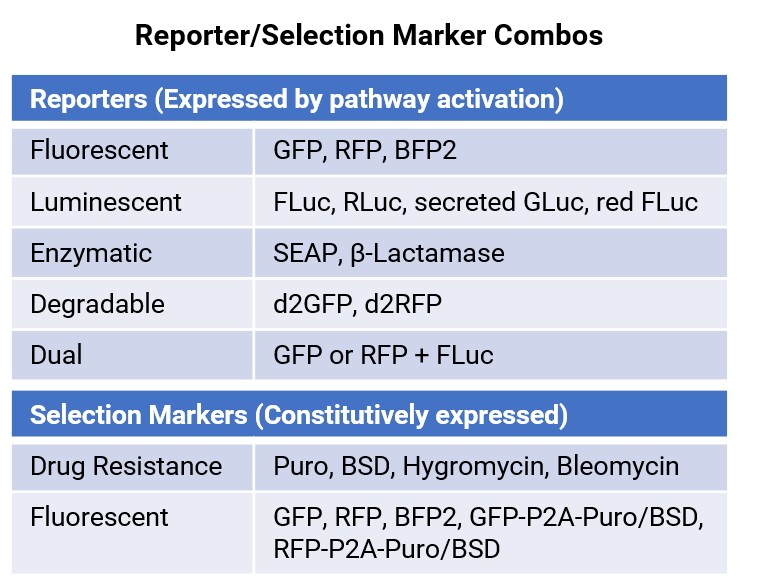
Additional Custom Service Options
- Send us your cells and we can establish a stable reporter cell line for you using this product. Learn more.
- ORF cDNA plasmids featured in the product figures are available upon request.
- Ultra-high concentration virus can be provided upon request in your choice of medium and volume (i.e. for in vivo applications).